
 Dr. Haitham Ahmed
Every year, parents and grandparents ask me the same question at baby showers, birthday parties, and holiday gatherings: "What should I get for a child who loves science?" Or more often: "I want to encourage my child toward medicine - what actually works?"
As a cardiologist, a children's book author, and a father, I have a clear answer. And it's probably not what most gift guides tell you.
The best gifts for future doctors aren't lab coats and toy stethoscopes - though those have their place. The best gifts are ones that build genuine curiosity, scientific vocabulary, and a sense that the human body is something wonderful and knowable. That foundation, planted early, matters far more than any single toy.
Here's my honest, physician-informed list for ages 0-6.
A note on age ranges: The gifts below are organized by age, but children develop at different rates. Use the ranges as a guide, not a rule. Many of these gifts grow with the child and remain valuable well beyond the suggested age.
For Babies (Ages 0-2)
The Little Doctors Book Set - Cardiology, Neurology & Cell Biology
Disclosure: I wrote these books. Three doctor-written board books covering the heart, brain, and cell - the three most fundamental concepts in medicine. Vivid illustrations, accurate science, and rhythmic text make them ideal for reading aloud from birth. I include them here because parents and physicians consistently tell me children ask for them repeatedly, and because I believe they fill a real gap in what's available for this age group.
Why it works: Real vocabulary, real science, real illustrations - not dumbed down. Babies absorb more than we think, and these books give them something genuinely worth absorbing.
Buy on AmazonMelissa & Doug Wooden Shape Sorting Cube
A classic for good reason. Shape sorting at this age develops spatial reasoning and problem-solving - foundational cognitive skills that underpin scientific thinking. The satisfaction of fitting the right shape into the right hole is, at its core, the same satisfaction a scientist feels when a hypothesis proves correct.
Why it works: Builds logical thinking and fine motor skills simultaneously. Durable enough to survive years of play.
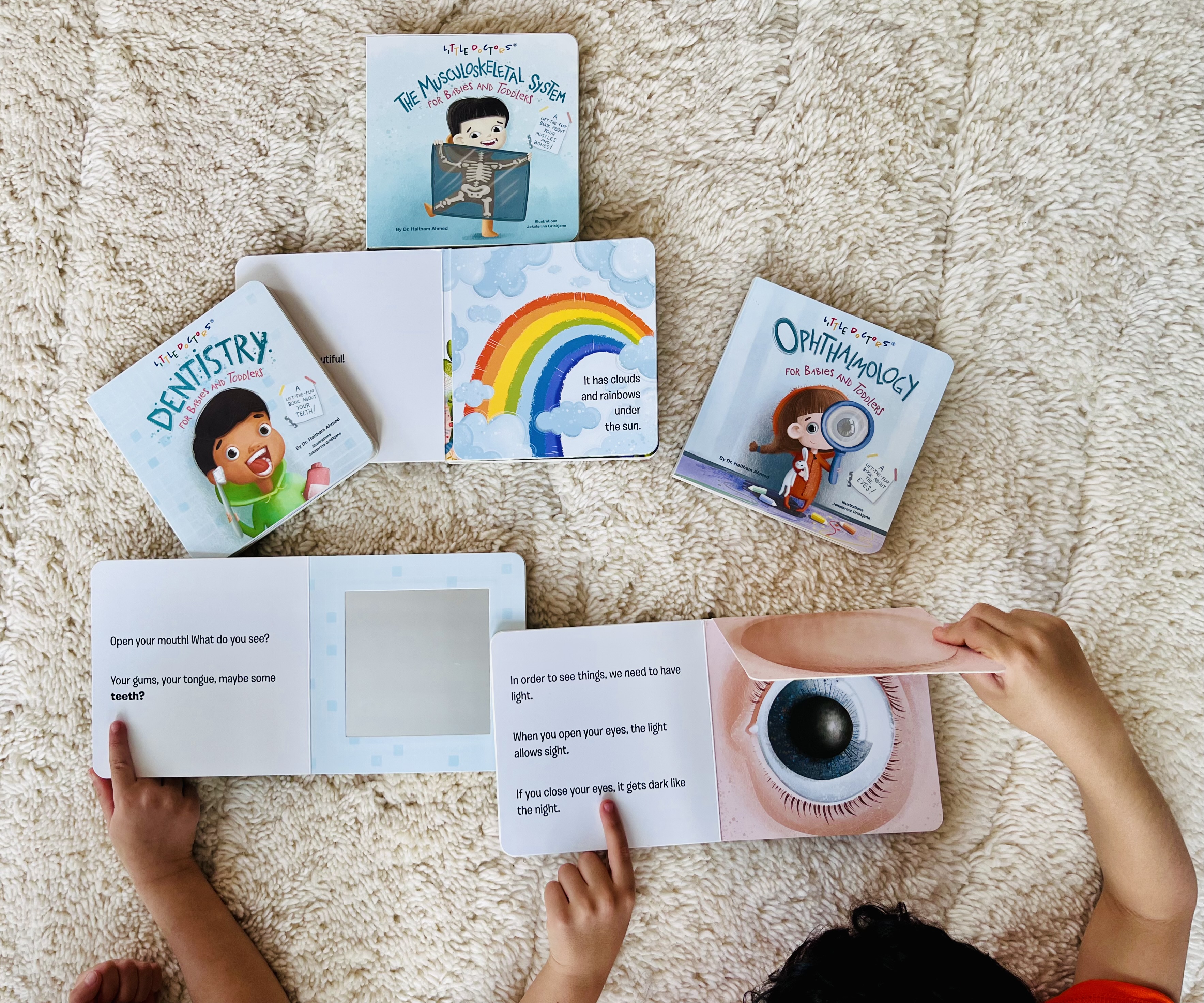
Buy on AmazonThe Little Doctors Lift-the-Flap Set - Ophthalmology, Dentistry & MSK
Disclosure: also mine. Three interactive lift-the-flap books covering the eyes, teeth, and musculoskeletal system. The flap format makes babies active participants rather than passive listeners - they're literally uncovering the science themselves. The Dentistry book includes a mirror page where children look at their own teeth, which never fails to delight.
Why it works: Interactivity dramatically improves retention at this age. Babies remember what they did, not just what they saw.
Buy on AmazonFor Toddlers (Ages 2-4)
Learning Resources Jumbo Magnetic Human Body
A large magnetic board with removable organ pieces that children can place in the correct position on a body outline. This hands-on format - physically placing the heart, lungs, stomach, and brain where they belong - creates a spatial understanding of anatomy that no book alone can match. It's the toy equivalent of a medical school anatomy lab.
Why it works: Kinesthetic learning (learning through physical manipulation) is especially powerful at ages 2-4. Children remember what their hands did.
Buy on AmazonThe Digestive System for Babies and Toddlers
Disclosure: also mine. Food is one of the first things toddlers are intensely curious about - so a book that follows food on its journey through the body is a natural fit. This book introduces the mouth, stomach, intestines, and more through vivid illustrations and interactive questions. Parents consistently tell me it opens conversations about nutrition and body awareness they never expected from a board book.
Why it works: Connects science to something the child already cares about - eating. That personal connection makes the learning stick.
Buy on AmazonMelissa & Doug Healthy Foods Cutting Set
A wooden cutting food set where children slice apart velcro-joined fruits and vegetables. This seems simple, but it builds categorization skills (this is a fruit, this is a vegetable), introduces nutrition concepts, and develops fine motor control. Pair it with the Digestive System book for a natural thematic combination.
Why it works: Play-based learning at this age is how science education starts - categorizing, observing, and manipulating objects in the real world.
Buy on AmazonFor Preschoolers (Ages 4-6)
The Little Doctors Handbook
Disclosure: also mine. Three books that put the child in the role of the doctor - covering symptoms, physical examination, and treatment. Children learn what doctors actually do during a check-up and then role-play it themselves. The pretend examinations that follow - conducted on stuffed animals, younger siblings, and unsuspecting grandparents - are both hilarious and genuinely educational.
Why it works: Role-play at this age is how children rehearse adult roles and internalize complex concepts. Playing doctor is literally practicing medicine at age 5.
Buy on AmazonLearning Resources Pretend & Play Doctor Set
A complete toy doctor's kit with a stethoscope, otoscope, blood pressure cuff, thermometer, and reflex hammer. The quality on the Learning Resources version is notably better than cheaper alternatives - the stethoscope actually amplifies sound faintly, which genuinely amazes children. Pair with the Little Doctors Handbook for the ultimate future-doctor gift combination.
Why it works: Tactile, open-ended play with real-looking medical tools builds sustained interest in medicine in a way that passive toys can't.
Buy on AmazonThames & Kosmos Kids First Science Laboratory
A proper beginner science kit with real experiments - not just mixing baking soda and vinegar, but actual structured scientific method: observe, hypothesize, test, record. The kit is designed to be parent-child collaborative, which makes it a great excuse for a science afternoon together. This is the age where hands-on experimentation starts to click.
Why it works: Introduces the scientific method - the most important concept in all of science - through play. A child who learns to form and test hypotheses at age 5 has a head start that compounds over years.
Buy on AmazonWhat to Avoid
A few things I'd steer clear of when gifting for a science-curious child:
- Oversimplified "baby science" books with made-up words. If a book invents childish names for real things ("tummy" instead of "stomach," "boo-boo" instead of "injury"), it's teaching the wrong vocabulary. Use the real words from the start.
- Screen-based "educational" toys with lots of flashing lights. The research on passive screen exposure for under-2s is not encouraging. Active, tactile, and social learning consistently outperforms it.
- Kits that are one-time-use. Science gifts that can only be used once (certain chemistry kits, for example) are less valuable than open-ended toys that invite repeated exploration.
The Best Gift of All
I'll end with something that costs nothing. The single most powerful gift you can give a child who you hope will love science is your own genuine curiosity.
When your child asks "why does my heart beat faster when I run?" - don't brush it off. Say "that's a great question - let's find out." When they ask what's inside their body, show them. When they ask how medicine works, tell them what you know and look up what you don't.
Children learn what adults around them treat as worth learning. A parent who is curious about science raises a curious child. No gift can substitute for that - but the right books and toys can make those conversations richer, more frequent, and more memorable.
That's exactly what I had in mind when I wrote the Little Doctors series. Not to replace the conversation - but to start it.
Disclosure: Several items on this list - the Little Doctors Book Set, Lift-the-Flap Set, Digestive System book, and Handbook - are part of the Little Doctors series, which I authored. All purchase links are affiliate links. All opinions are my own.