
 Dr. Haitham Ahmed
My toddler put their hand on my chest one morning and said: "Daddy, what's that noise?"
They had felt my heartbeat - and they wanted to know what it was.
As a cardiologist, I've spent years studying the heart in extraordinary detail. I know its embryological development, its electrophysiology, its hemodynamics under stress. But in that moment, what I needed to do was explain it to a two-year-old in a way that was accurate, engaging, and actually meaningful to them.
That question - and hundreds like it from my own children - is part of what led me to write Cardiology for Babies. But it also gave me a framework for how to talk about the heart at any age, starting from the very first time a curious toddler presses their ear to your chest and asks what they're hearing.
Here is that framework.
Why Toddlers Are Ready to Learn About the Heart
The conventional wisdom is that complex biology is too advanced for young children. I disagree - and so does the research on early childhood cognitive development.
Toddlers are not limited by their ability to absorb complex concepts. They're limited by the quality of the explanation they receive. A bad explanation of quantum physics will confuse a physicist. A good explanation of cardiac anatomy can genuinely engage a two-year-old.
The heart is actually one of the best entry points into human biology for young children because:
- They can feel it. Put a toddler's hand on their own chest after they run around and they immediately feel the heart beating faster. That's direct, tangible, real-time biology.
- It's dramatic. The heart beats 100,000 times a day. It pumps 2,000 gallons of blood per day. These numbers are genuinely astonishing to a child - and to most adults.
- It's personal. Every toddler is deeply interested in their own body. The heart is literally inside them, working right now, this very second. That immediacy captures attention in a way abstract concepts cannot.
- The vocabulary is learnable. "Heart," "pump," "blood," "beat," "chambers" - these are words toddlers can learn and use. And once they use them, they own the concept in a way that passive exposure never achieves.
The key insight: Don't ask whether your toddler is "ready" to learn about the heart. Ask whether you're ready to explain it well. The readiness is yours to provide - not theirs to demonstrate first.
How to Explain the Heart by Age
Start with sound and sensation
At this age, explanations in the traditional sense aren't the goal. What you're doing is building familiarity - creating a positive, curious association with the heart before they can even ask questions about it. Read Cardiology for Babies aloud. Let them touch your chest and feel the heartbeat. Let them hear the word "heart" repeated in a warm, engaged context. The vocabulary is being absorbed even if comprehension isn't yet possible.
The pump analogy
At this age, toddlers understand cause and effect. They know that squeezing something pushes liquid out - they've squeezed a water bottle, a bath toy, a tube of toothpaste. That's your entry point. The heart is a pump. It squeezes blood out and pushes it around the whole body. Keep it that simple. The word "pump" does a lot of work here - it's accurate, it's physical, and it connects to experiences they already have.
Add the delivery system
Three and four year olds can handle a more complete story. Now you can introduce the idea that blood carries something - oxygen, which the body needs to work. The heart pumps blood to the lungs to pick up oxygen, then pumps that oxygen-rich blood everywhere else. You can introduce the idea of blood vessels as tubes or roads that blood travels through. The circulatory system as a delivery network is a concept most four-year-olds can genuinely grasp and find fascinating.
Introduce the chambers
By age four or five, children can understand that the heart has different rooms - chambers - with different jobs. The right side of the heart sends blood to the lungs. The left side pumps it to the rest of the body. You can use your hands to demonstrate: the right hand pumps to the lungs, the left hand pumps to the body. This is genuinely accurate cardiac anatomy, made accessible through gesture and story. Children at this age often become intensely interested in what happens when the heart doesn't work right - which opens naturally into conversations about why doctors and healthy habits matter.
Activities That Make the Heart Real
Explanations work better when paired with physical experiences. Here are a few that are particularly effective:
1. Feel the resting heartbeat
Sit quietly with your toddler. Place their hand on their chest (left side, slightly). Count the beats together out loud. Then run around the room for 30 seconds and feel it again. The change is immediate and dramatic - and it opens a natural conversation about why the heart beats faster when we exercise.
2. The squeeze demonstration
Fill a small soft ball or squeeze toy with water (or just use an empty one). Show your toddler how squeezing it pushes the contents out. "This is what your heart does - it squeezes, and the blood shoots out." Simple, physical, and accurate.
3. Listen with a toy stethoscope
A toy stethoscope from a doctor kit (or a real one if you have one) lets toddlers listen to their own heartbeat - and yours. This is invariably one of the most exciting moments for a young child who has been learning about the heart. Hearing it directly, through an instrument, makes the abstract suddenly visceral and real.
4. Read Cardiology for Babies together
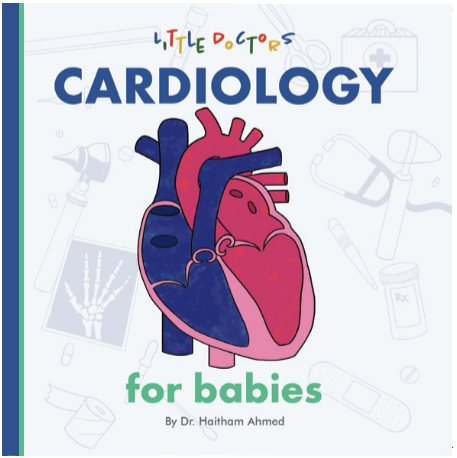
The illustrations in Cardiology for Babies show the heart in cross-section - the four chambers, the major vessels, the flow of blood - in a way that is visually clear and anatomically accurate. Reading it after a physical activity, when the child can actually feel their heart pounding, creates a powerful connection between the illustration and the lived experience.
From a cardiologist: The single most common cardiovascular risk factor I see in adult patients is a lifelong lack of understanding of how the heart works - and therefore no real motivation to protect it. Children who learn about the heart early develop a genuine relationship with it. They understand why exercise matters. Why smoking destroys it. Why diet affects it. That understanding, planted at age three, is one of the most powerful preventive health interventions that exists.
What Not to Say
A few common mistakes when explaining the heart to toddlers:
- Don't say "it's too complicated." It isn't. It's only complicated if explained poorly. The heart pumps blood. That's the core concept. Everything else is detail added gradually over years.
- Don't use made-up baby words. "Ticker" and "lub-dub machine" are charming but they don't give the child anything to build on. Use "heart," "pump," "blood," "chambers" from the beginning. These are the words they'll encounter for the rest of their life.
- Don't worry about overwhelming them. If a toddler loses interest, they'll let you know. If they're engaged, they'll ask questions. Follow their lead - but don't preemptively limit what you offer them.
- Don't make it scary. The heart is a marvel, not a threat. Keep the tone one of wonder and fascination. "Isn't it amazing that your heart never takes a break?" rather than anything that implies fragility or danger.
The Bigger Picture
I became a cardiologist because I find the heart extraordinary. Not just medically - philosophically. The heart begins beating at around 6 weeks of gestation and doesn't stop until the moment of death. It beats approximately 3 billion times in an average lifetime. It adjusts its rate within seconds to meet the body's changing demands. It is one of the most reliable machines in the known universe.
I want my children to know this. I want them to grow up with a sense of genuine wonder at what's happening inside their own chest, right now, as they read this. That wonder is the foundation of a healthy relationship with their own body - and ultimately, with science itself.
The conversation starts with a two-year-old pressing their ear to your chest and asking what that noise is. Don't brush the question off. That's your opening.
Take it.
Cardiology for Babies - Dr. Haitham Ahmed
The book that started the Little Doctors series - introducing the heart to babies and toddlers through vivid anatomical illustrations and simple, rhythmic text. Written by a board-certified cardiologist. 4.8 stars across 500+ Amazon reviews. Ages 0–6.
Buy on Amazon