
 Dr. Haitham Ahmed
Two years old is one of the most remarkable moments in human development. Language is exploding - most 2-year-olds add several new words to their vocabulary every single day. Curiosity is at its peak. The world is endlessly interesting. And the brain is operating at a level of plasticity that won't return.
The books you read to a 2-year-old matter more than most parents realize. Not because a single book changes everything, but because the cumulative effect of hundreds of reading sessions - the vocabulary introduced, the concepts explored, the questions sparked - shapes the way a child thinks about the world for years to come.
As a cardiologist, a father, and a children's book author, I think carefully about what goes into a child's mind during these early years. Here is my honest list of the best books for 2-year-olds - drawn from a broad range of authors and publishers, with two titles from my own series included and disclosed.
What Makes a Book Right for a 2-Year-Old?
Before the list, it's worth understanding what a 2-year-old brain needs from a book:
- Rich vocabulary. Two-year-olds are in the midst of the greatest language acquisition window of their lives. Books that use real, specific words - not invented baby-talk - give their developing brains more to work with. Don't shy away from "cardiac," "neuron," or "photosynthesis." Context makes meaning.
- Repetition. The book your 2-year-old demands for the hundredth time is doing important neurological work. Repetition is how the brain consolidates learning. A great book for this age rewards repeated reading by revealing something new each time.
- Interactivity. At 2, children want to be participants, not spectators. Lift-the-flap, touch-and-feel, mirror pages, and books with questions they can answer make the reading experience active rather than passive.
- Concepts that connect to their world. Two-year-olds are intensely interested in bodies, food, animals, faces, and how things work. Books that connect abstract concepts to things they already care about are absorbed more readily and remembered longer.
- Durability. Board books are the right format at this age. A 2-year-old is not yet gentle. If the book can't survive being carried around, sat on, and occasionally thrown, it won't be read enough to matter.
The most important quality in a book for a 2-year-old: it should be one you enjoy reading aloud. Your enthusiasm is contagious. A parent who finds a book genuinely interesting communicates that interest to their child - and that emotional signal is as educational as anything on the page.
The Best Books for 2-Year-Olds
The Very Hungry Caterpillar - Eric Carle
Eric Carle's masterpiece has been in print for over 50 years because it works. The counting, the food, the transformation from caterpillar to butterfly, and the distinctive collage illustrations combine to create a book that rewards dozens of readings. From a developmental standpoint, it introduces sequencing (a precursor to logical thinking), counting, and the concept of metamorphosis - actual science, wrapped in story. The die-cut holes are a tactile element that 2-year-olds find irresistible, and the repetitive structure makes it easy for children to participate from memory before they can read a word.
Buy on AmazonBaby Loves Quantum Physics - Ruth Spiro
Ruth Spiro's Baby Loves Science series is a genuine achievement in science communication for very young children. Baby Loves Quantum Physics introduces wave-particle duality through the experience of blowing bubbles - somehow making it feel completely natural. The science is reviewed by actual physicists, which shows. Two-year-olds won't grasp quantum mechanics, but they will absorb the vocabulary, the sense of wonder, and the message that the universe is strange, beautiful, and worth investigating. The series also covers thermodynamics, aerospace engineering, and coding - a well-rounded library on its own.
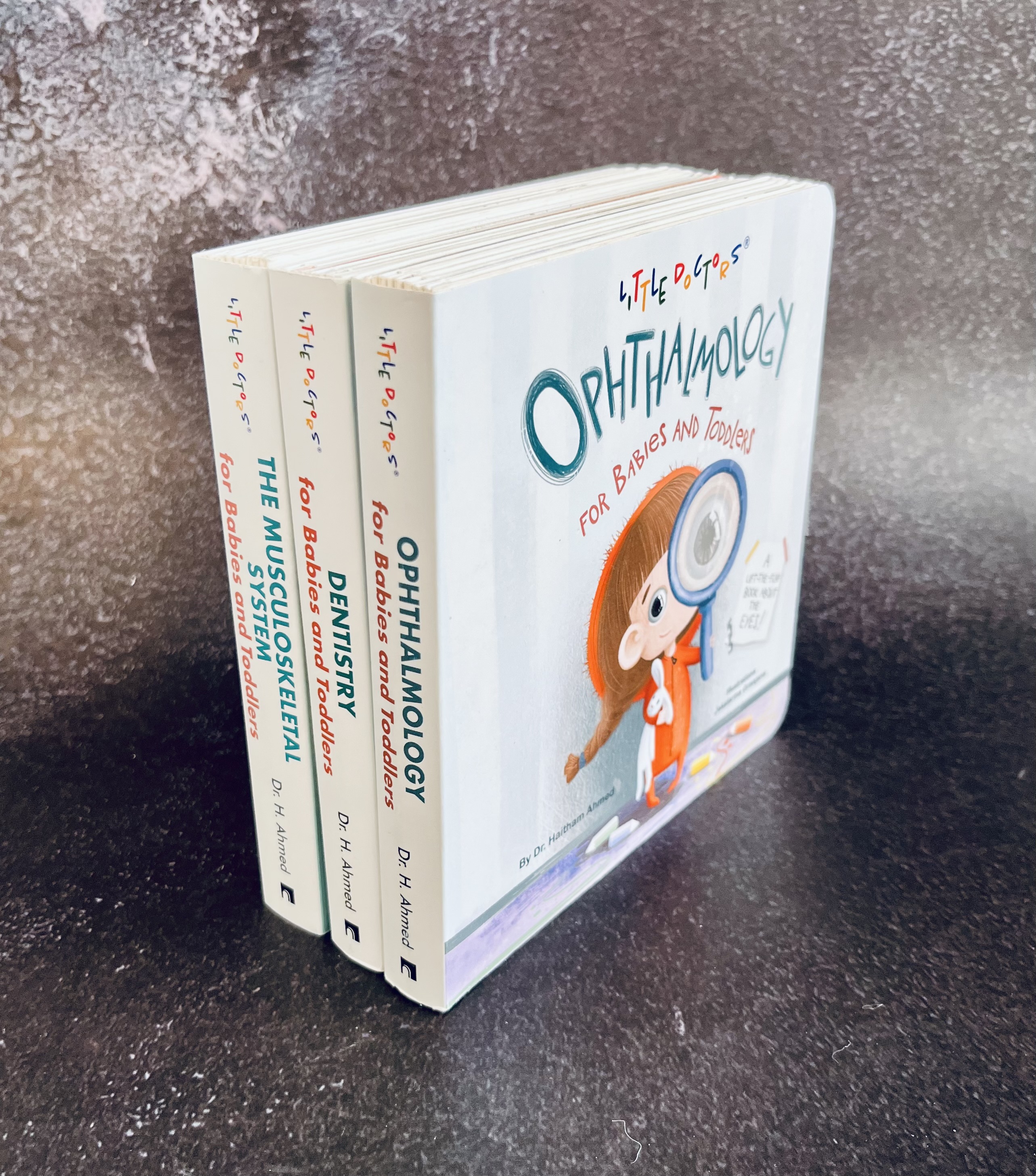
Buy on AmazonOphthalmology for Babies and Toddlers - Dr. Haitham Ahmed
Disclosure: I wrote this book. The lift-the-flap format is perfectly suited to 2-year-olds who want to be active participants in everything. Children lift flaps to reveal the inner structure of the eye, discover how light travels to form images, and look at their own eyes in a mirror page - invariably a highlight. Two-year-olds are intensely interested in faces and eyes, which makes the subject matter a natural fit. The science is accurate - the cornea, lens, retina, and optic nerve are all represented correctly - and the interactive format means children return to it again and again, each time discovering something new.
Buy on AmazonGoodnight Moon - Margaret Wise Brown
The bedtime book against which all other bedtime books are measured. What makes Goodnight Moon developmentally powerful is not just the soothing rhythm - it's the attention to detail. The room changes subtly across each page spread: the light dims, the mouse moves, the clock advances. Two-year-olds who read this book repeatedly begin noticing these changes, which develops observational skills and attention to detail - foundational scientific habits of mind. The quiet, deliberate pacing also models the kind of focused, unhurried attention that reading requires, which is one of the most valuable things a bedtime book can do.
Buy on AmazonNeurology for Babies - Dr. Haitham Ahmed
Disclosure: also mine. Two-year-olds are fascinated by their own bodies - and nothing is more fascinating, or more important, than the brain. This board book introduces neurons, synapses, and the different regions of the brain through colorful illustrations that make the brain look as beautiful as it actually is. The rainbow-colored brain lobes are visually striking and immediately memorable. Many parents tell me that after reading this book, their 2-year-old will point to their head and say "that's my brain" with a seriousness that makes you realize how much they've absorbed. The book also opens natural conversations about emotions, thinking, and learning.
Buy on AmazonWhere's Spot? - Eric Hill
The original lift-the-flap book - and still one of the best. The simple premise (where is the puppy hiding?) gives 2-year-olds a goal that drives the reading experience. Each flap opened is a small hypothesis tested: is Spot behind the door? Under the rug? Inside the box? This is, at its most basic level, the scientific method: predict, test, observe. The repetitive structure also builds narrative comprehension - the child begins to understand how stories work, which is one of the most important cognitive skills a young child can develop. It's also extremely durable, which matters at this age.
Buy on AmazonNational Geographic Little Kids First Big Book of Why - Amy Shields
This question-and-answer book tackles the "why" questions 2-year-olds ask constantly - why is the sky blue, why do dogs have wet noses, why do we need sleep - with accurate, engaging answers and the stunning photography that National Geographic does better than anyone. The format is perfectly calibrated for this age: a child asks why, an adult reads the answer, and the photographs make the concept concrete and memorable. It's also genuinely useful for parents, who often find themselves reaching for it independently. A Wall Street Journal bestseller, and one of the few books in this category that rewards the adult reader as much as the child.
Buy on AmazonRosie Revere, Engineer - Andrea Beaty
A picture book that works beautifully for 2-year-olds on a parent's lap and grows with the child through age 6. Rosie is a young girl who builds flying machines in secret and is terrified of failure - until her great-great-aunt helps her see that a failed first attempt is just a great beginning. The message about persistence and the engineering mindset is delivered warmly, without being preachy. Illustrations by David Roberts are detailed and funny, giving each reading something new to notice. The companion Ada Twist, Scientist is equally strong and worth reading alongside it.
Buy on AmazonWhat to Avoid at This Age
A few types of books that are popular but worth being cautious about for 2-year-olds specifically:
- Books that talk down to children. If a book uses made-up words for real things ("tummy" instead of "stomach," "boo-boo" instead of "injury"), it's teaching the wrong vocabulary during the most important language window of a child's life. Use the real words. Children can handle them.
- Books with no re-read value. Many children's books exhaust their content in a single reading. The best books for 2-year-olds reveal something new on the tenth reading that wasn't visible on the first. If a book has nothing to offer on the second reading, it's not worth much - because 2-year-olds require repetition to learn.
- Books that replace thinking with spectacle. Highly stimulating books with dense visual noise and no narrative thread can undermine the focused attention that reading is meant to develop. Simplicity and depth are more valuable than visual excitement at this age.
How to Read to a 2-Year-Old: A Few Practical Notes
The books matter, but so does how you read them. A few things that make a real difference at this age:
- Let them control the pace. If your 2-year-old wants to spend five minutes on one page, let them. They're processing, not dawdling.
- Ask questions as you read. "What do you think that is?" "What's going to happen next?" Questions turn reading from a passive to an active experience.
- Connect the book to real life. "Remember when we went to the doctor? This is what a stethoscope does." Connections between books and experience deepen learning in both directions.
- Don't worry about finishing. A 2-year-old who loses interest halfway through a book isn't failing at reading - they're telling you something important about their attention. Stop, and try again another time.
- Read the same books repeatedly. The book your child demands for the thirtieth time is more educational than a new book they've never seen. Lean into repetition rather than variety.
The single most important thing: read every day. Not for a set amount of time, not from a prescribed list - just read, every day, whatever your child is interested in. The cumulative effect of daily reading from age 0 to age 5 is one of the strongest predictors of school readiness and academic success we know of. The books in this list are tools. The habit is what matters.
Disclosure: Two books on this list - Ophthalmology for Babies and Toddlers and Neurology for Babies - are part of the Little Doctors series, which I authored. Purchase links throughout this article are affiliate links. All opinions are my own.