
 Dr. Haitham Ahmed
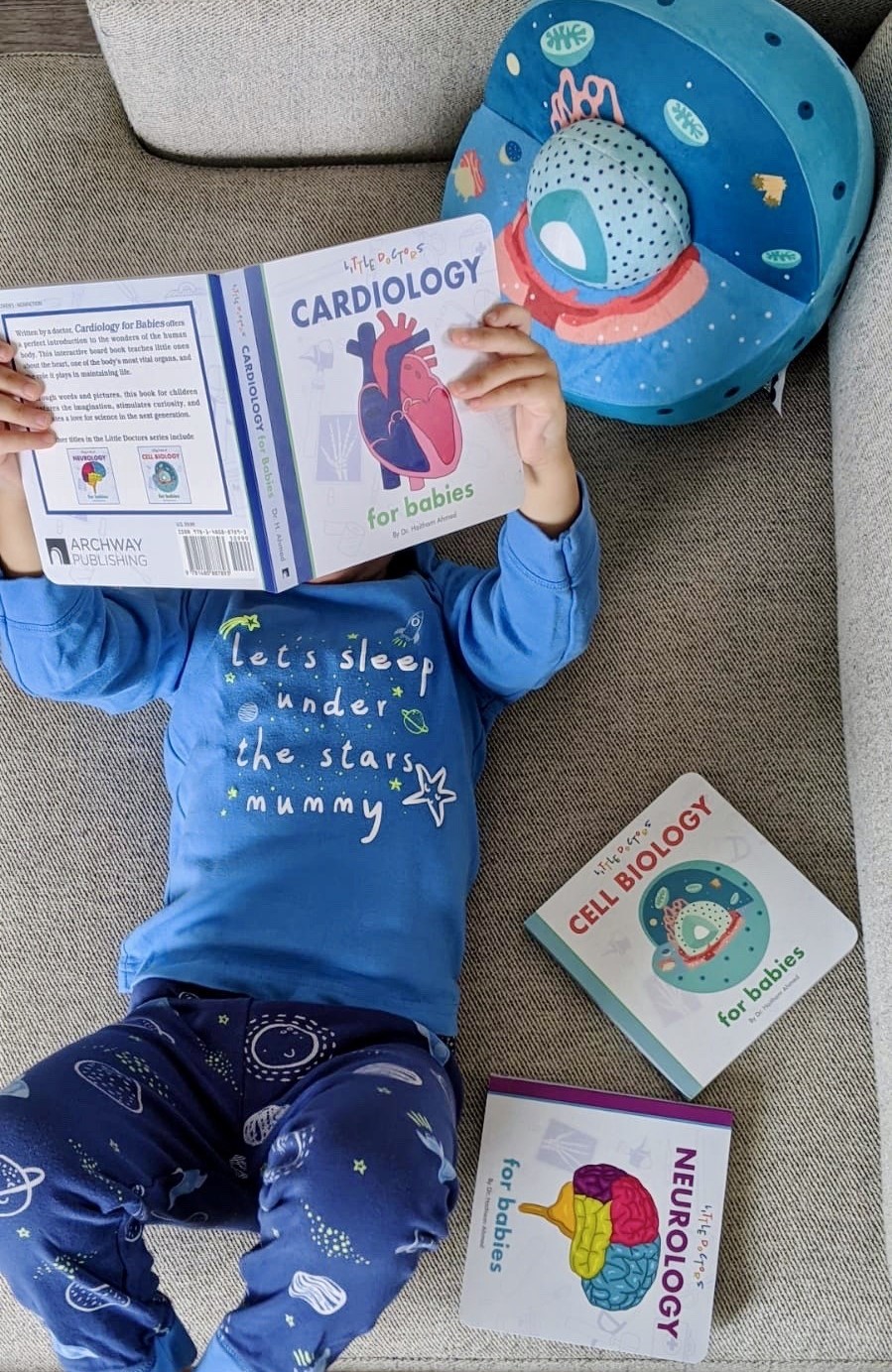
It's one of the most common questions I hear from new parents: when should I start reading to my baby? The answer, as a physician and as a father, is the same: earlier than you think. Much earlier.
In fact, the honest answer is that there is no minimum age. You can - and should - start reading to your baby from day one.
I know that sounds surprising. A newborn can't understand words. They can barely focus their eyes. What could they possibly get out of a board book?
More than you'd expect. Here's the science.
What Happens in a Baby's Brain During Reading
A newborn's brain contains roughly 100 billion neurons - the same number as an adult. But the connections between those neurons, called synapses, are still being formed. In the first three years of life, the brain forms an astonishing one million new neural connections every single second.
Language exposure is one of the most powerful drivers of synapse formation. Every word your baby hears - even words they can't yet understand - is helping wire the language centers of their brain. The more words they hear in the early months and years, the stronger and more complex that wiring becomes.
This is what researchers call the "word gap" - the documented difference in vocabulary and cognitive development between children who were spoken and read to frequently in infancy versus those who weren't. The effects are measurable as early as 18 months and persist into school age and beyond.
The research is clear: children who are read to from birth hear millions more words by age 5 than those who aren't. That head start in vocabulary and comprehension is one of the strongest predictors of academic success.
Month by Month: What Your Baby Gets From Reading
0-3 Months
At this age your baby is hearing your voice and beginning to associate it with safety, comfort, and love. Reading aloud - even from a medical textbook, honestly - exposes them to the rhythm and cadence of language. They're not processing the words yet, but they're learning that language has patterns, emphasis, and emotion. Board books with high-contrast imagery are ideal at this stage since newborn vision is limited to about 8-12 inches and responds most strongly to bold, simple shapes and faces.
3-6 Months
Babies at this age start responding to your voice with coos and expressions. They'll begin tracking images with their eyes and reacting to changes in your tone. This is when colorful illustrations start becoming meaningful - the brain is beginning to process visual information more richly. Reading together becomes a genuine back-and-forth interaction, and simple naming ("that's the heart - it pumps blood around your body") begins to register.
6-12 Months
This is when things get exciting. Babies start babbling, reaching for books, and showing preferences for certain stories. They recognize familiar images and anticipate repeated phrases. The interactive elements of board books - lift-the-flap, textures, mirrors - become genuinely engaging. This is a wonderful stage to introduce books about the human body, because babies are intensely curious about faces, hands, and the world around them.
12-24 Months
Toddlers at this age are vocabulary sponges. Every word in every book is being catalogued. This is the stage where reading science books pays off most visibly - children at 18 months can learn and retain words like "neuron," "cardiac," and "photosynthesis" if they've heard them repeatedly in context. Don't underestimate what they're absorbing.
Does It Matter What You Read?
For very young babies - under three months - the content matters less than the act. Your voice, your presence, and the rhythm of language are what count.
But from around three to four months onward, the content begins to matter more. Books with rich vocabulary - real words, not invented baby-talk - give developing brains more to work with. Books with accurate information plant seeds that grow. And books that introduce concepts like biology, anatomy, and science do something especially valuable: they frame the natural world as something understandable and worth exploring.
This is part of why I wrote the Little Doctors series (disclosure: these are my books). Not because I expected one-year-olds to understand cardiology - but because I knew that repeated, joyful exposure to real scientific vocabulary in infancy would make those subjects feel familiar and approachable for life. Different titles in the series are better suited to different developmental stages, which I'll explain below.
The best book to read to your baby is one that you enjoy reading aloud. Your enthusiasm is contagious - babies read your emotional cues as much as they absorb your words.
Practical Tips for Reading to Babies and Toddlers
- Start today, regardless of age. There is no stage too early. Even a newborn benefits from hearing your voice read aloud.
- Read with expression. Change your pitch, slow down for emphasis, use different voices. Your vocal variety stimulates more brain activity than a monotone reading.
- Don't worry about finishing the book. If your baby loses interest, stop. Short, frequent reading sessions are more valuable than long forced ones.
- Point to and name what you see. "Look - that's the heart. It pumps blood." Connecting words to images accelerates vocabulary development.
- Repeat favorite books. Repetition is not boring to a baby's brain - it's how learning is consolidated. The book your toddler wants read for the hundredth time is doing important neurological work.
- Make it part of your routine. Bedtime reading creates a reliable association between books and calm - a habit that tends to persist into childhood and beyond.
How the Little Doctors Series Maps to Each Stage
Since parents often ask me which of my books to start with, here's an honest guide to how I'd sequence them by developmental stage. These are my own books and I'm disclosing that clearly - but the developmental reasoning behind the sequencing is genuine.
mos
Cardiology for Babies
The bold anatomical illustrations of the heart - vivid reds and blues against clean backgrounds - make this well-suited to young babies whose vision responds most strongly to high contrast. The text is short and rhythmic, easy to read aloud with warmth. Hearing "heart," "pump," and "blood" in the first weeks of life plants vocabulary seeds that quietly germinate. The heart is also one of the most emotionally resonant organs - there's something fitting about starting there.
Buy on Amazonmos
Cell Biology for Babies
The color-coded cell illustrations - each organelle a distinct, memorable hue - are ideal for the 6-18 month stage when babies are actively processing visual information and beginning to point and name things. "Can you find the nucleus?" becomes a real interactive game at this age. This is also our bestselling title, and the one parents most often tell me their children request by name once they're old enough to ask. The cell is the right concept for this stage: fundamental, visual, and just abstract enough to feel like magic.
Buy on Amazonmos
Ophthalmology for Babies and Toddlers
The lift-the-flap format requires the fine motor control and intentionality that develops around 18 months, making this a natural next step. Toddlers lift flaps to reveal the inner workings of the eye, and the mirror page - where they look at their own eyes - connects the science directly to their own body, which is exactly what this developmental stage craves. Two-year-olds are intensely curious about faces and senses, and the eye is a subject that rewards that curiosity with real, accurate anatomy.
Buy on Amazonyrs
The Little Doctors Handbook
For preschoolers ready to role-play, this three-part set - covering Symptoms, Physical Examination, and Treatment - puts the child in the role of the doctor. At this age, children learn by doing and by pretending, and the Handbook channels that instinct directly into medical education. The examinations children conduct on stuffed animals and family members after reading this book are genuinely remarkable to watch. It's the series title that most directly reflects the developmental reality of ages 3-6: learning through imaginative play.
Buy on AmazonDisclosure: All four books listed above are part of the Little Doctors series, which I authored. They're included here as examples of how book format and content can be matched to developmental stage - not as the only options. Purchase links are affiliate links.
The Bottom Line
Start reading to your baby today. Not when they can talk. Not when they seem "ready." Today.
Every book you read before they understand a single word is an investment in the brain they're building. Every scientific term they hear in the warmth of your lap becomes a familiar friend rather than an intimidating stranger when they encounter it in school years later.
The window of peak neural plasticity is open right now. Use it.